When Work Feels Personal: Navigating Life’s Challenges with Empathy
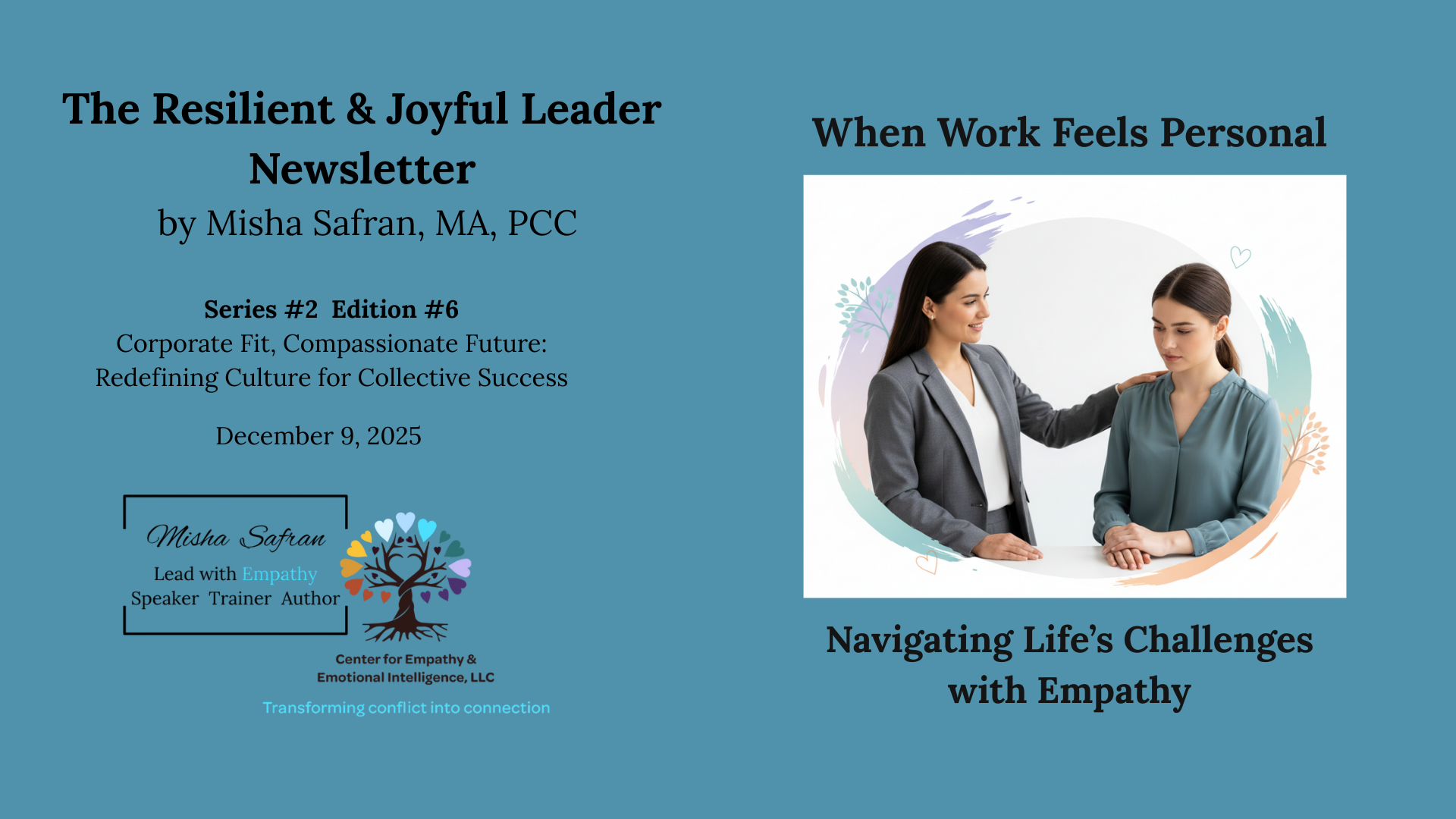
When Work Feels Personal: Navigating Life’s Challenges with Empathy
Strategies for leaders to support employees through divorce, grief, illness, and other life transitions
Why It Matters
I often say: when personal choices do not affect professional life, something has usually shut down between us. The truth is that our lives always come with us. Divorce, breakups, grief, illness, parenting, becoming a grandparent, going back to school, starting or ending relationships: these experiences shape how we show up, whether we talk about them or not.
In our recent LinkedIn Live conversation, Jackie Roby and Dr. Jaime Gabriel Raygoza both named what many of us were taught: keep work and life separate. Yet as Dr. Jaime reminded us, we are not robots. There is no clean line where one ends and the other begins.
Jackie shared about navigating depression and complex trauma early in her career and how isolating it felt at work. She later recognized colleagues who were struggling too and saw how afraid they were to be seen as “weak.” That silence was a missed opportunity for connection, understanding, and growth, both personally and organizationally.
I have lived this as well. My own divorce once spilled into my classroom in ways I did not handle well. Students felt it, and I was grateful that some had the courage to tell me so. Yet, they shouldn't have had to. That feedback was painful, and it was also a turning point. I had to relearn how to show up, not by pretending everything was fine, but by becoming more intentional about what vulnerability at work could look like. I also needed to get support from my work to be able to take better care of myself so I could show up differently for myself and my students.
Empathy is not an excuse. It is a powerful tool for connection. It does not mean there are no expectations. It means we create structures where people can be honest about their capacity and still be accountable.
➽ The Leadership Edge
Leadership can sometimes feel like we are have to act as if we were untouched by life. When in reality, it is about how we move through it and how we model that movement for others.
Jackie encouraged leaders to use strengths they already have. If you can assess risk, build strategies, and ask for help in business, you can bring that same mindset to your own life transitions. She pointed out that many leaders handle the logistics of crisis, such as lawyers and housing, yet avoid the inner work. When that inner storm is ignored, it keeps spinning. Asking for support, at work and beyond, is actually good leadership, not failure.
Dr. Jaime offered a powerful story about starting a new leadership role while going through a painful breakup. In the middle of a work drive, he received the message that the relationship was over and began to cry. In that moment he had a choice: hide it or be honest. When asked by his colleague if he was okay, he chose to respond this way: “I am not okay, and I still plan to show up. I just need a few minutes to ground myself.” That moment of vulnerability opened the door for his colleague to share that she had just gone through her own breakup. What started as distance became connection, trust, and eventually a healthier team culture.
Dr. Jaime also shared a practical tool, inspired by Brené Brown, which he uses with teams: a simple “battery check.” Before a meeting, each person shares their current energy level, such as “I am at 70 percent today.” You do not have to disclose why, but you name your capacity. This reduces assumptions and helps distribute workload with more care and fairness.
Jackie highlighted another critical piece: organizational responsibility. Encourage mental wellness days. Offer resources so people know where to turn. Invest in therapy and coaching. She named that coaching, in particular, is often not covered by insurance, yet it is a powerful way to help leaders and staff move forward with clarity and confidence.
As a credentialed coach through the International Coaching Federation, I am biased - but rightfully so! The support coaching provides for people to do peopling better is high level if done well. Coaching supports people to move from where they are to where they want to be. Support is not about fixing people’s lives. It is about refusing to make them carry everything in silence. Coaching empowers people to untap and unlock the answers they have inside of them.
💜 Quick Tips (and Why They Matter)
1. Normalize honest check-ins. Try a brief “battery level” round at the start of a team meeting: “On a scale from 0 to 100, where is your energy today?” Why it matters: People feel seen without being forced to disclose details. You gain useful information about capacity and can adjust expectations accordingly.
2. Name your reality with care. If you are going through a major transition, you do not need to share everything. You can say something like, “I am navigating some personal changes right now. I am committed to this work, and I may need a bit more space or flexibility as I move through it.” Why it matters: This models vulnerability with boundaries. It gives others permission to be human without turning the workplace into a confessional.
3. Put support in the budget, not just in words. If you are in a position to influence policy, consider mental wellness days, access to mental health resources, and reimbursement or stipends for coaching and professional development. Why it matters: “Open door” language is not enough. Investment shows people you value their well-being and their future in the organization. It is also far less costly than constant turnover. Feel free to reach out to me or my panelists to get more information on how we can support you.
🤔 Reflection Questions
When someone on my team is clearly struggling, what is my usual pattern: ignore, overfunction, or connect with curiosity?
Where have I expected people to “tough it out” instead of inviting a conversation about capacity and support?
What would compassionate, sustainable support look like for me if I were the one going through a major life change?
🙆🏽♀️ Stretch Challenge
This week, choose one of these actions:
Do a “battery check” with your team or a small group and adjust expectations based on what you hear. And yes, you can even try this at home!
Reach out to one person who may be carrying a lot, with a simple message: “I am thinking of you. If there is a way I can support you in making work feel more manageable this week, let me know.”
Then notice: what shifts in trust, tone, or engagement?
🎶 A Final Note (for now 😉)
Work will always feel personal, because people are personal. The question is not whether life will spill into work. The question is whether leaders and organizations will meet that reality with avoidance or with empathy, structure, and care.
My deepest gratitude to Jackie Roby and Dr. Jaime G. Raygoza for sharing their stories, wisdom, and tools in our conversation. Leaders like them remind us that empathy and boundaries are partners, not opposites.
👉 If you or your organization is ready to build cultures where people can be human, accountable, and supported at the same time, I would love to help. Through keynotes, leadership trainings, and coaching, I support teams in navigating life’s challenges with emotional intelligence, clarity, and compassion...and of course a bit of JOY!
🌶️ Here is your Call to Action (besides to take care of YOU)
If this topic resonated with you, I invite you to take the next step in strengthening your empathy and leadership skills.
1. Take the Empathy Assessment Gain insight into your strengths and growth areas as a compassionate leader. 👉 Take the assessment HERE
2. Join a Free Workshop These sessions offer practical tools you can use immediately to build connection, navigate conflict, and strengthen emotional intelligence across your team.
Transform Conflict into Connection hosted by DoMoreGood.com– December 11, 2025 👉 Register HERE
Empathy & Emotional Intelligence at Work – December 22, 2025 👉 Register HERE
3. Take a moment to learn more about me and my wonderful panelists here: Jackie Roby, Dr. Jaime Gabriel Raygoza & 💜🎤Misha Safran, PCC, MA🎤💜
4. 👉🏽 You can watch the replay of our conversation HERE
Leading with empathy is a daily practice and you do not have to do it alone. I’d love to support you and your organization as you build cultures where people feel safe, supported, and fully human.
With Empathy and Joy
Misha Safran, MA, PCC
Keynote Speaker & Leadership Trainer and Coach
Land Acknowledgement: Born on the land of the Anacostans, Piscataway, and Pamunkey peoples. Currently living on Karkin Ohlone land.
All are valued in my practice: BIPOC, LGBTQIA+, humans of all backgrounds and ages. I hope to support a safer and braver space for all professionals to do peopling better.